


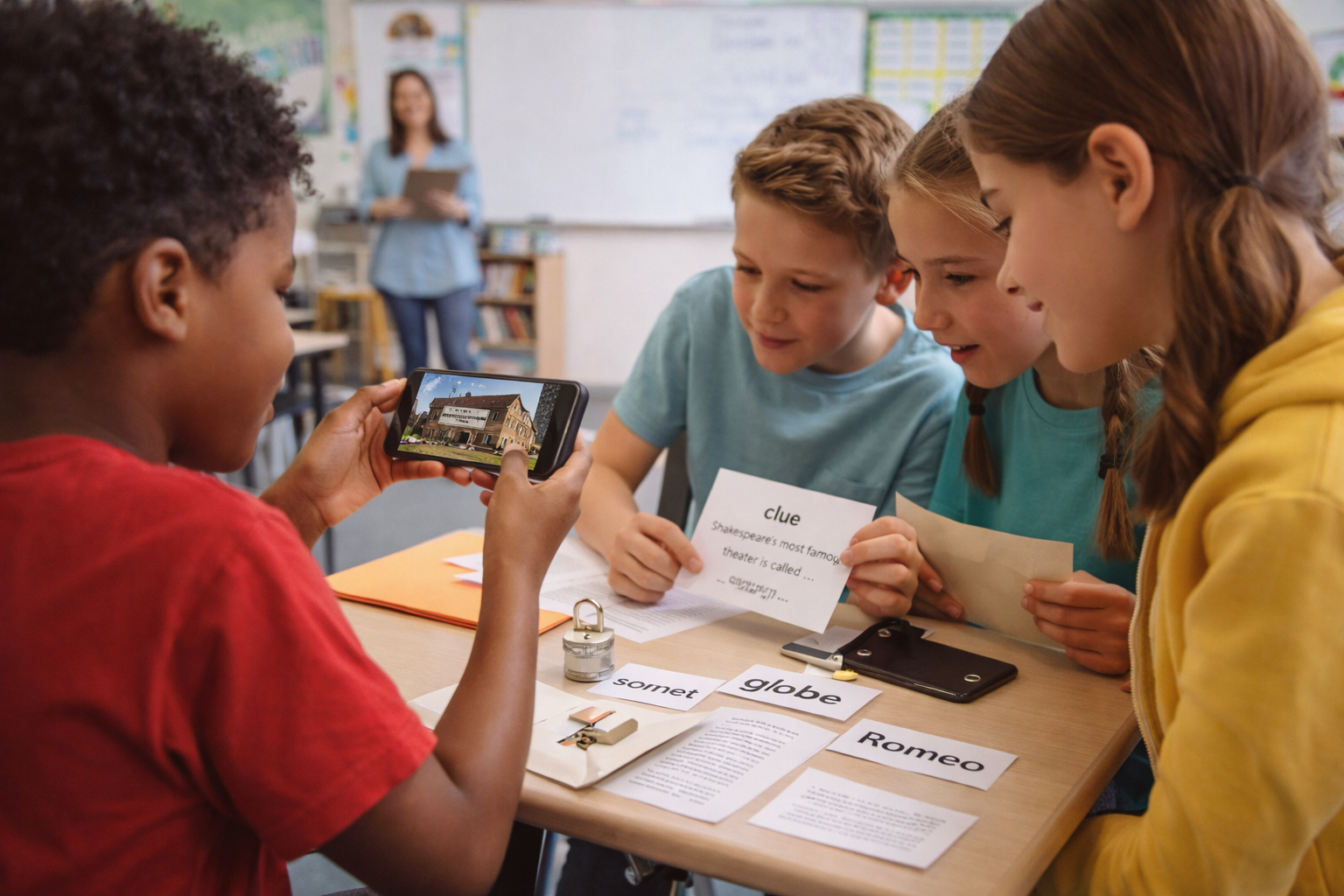
Teachers know that language learning is most effective when students are actively involved; communicating, collaborating, and solving real problems together. A recent study published in Computers introduces an exciting classroom innovation: an augmented reality escape game designed to teach English as a Foreign Language (EFL).
Rather than a traditional lesson, the learning activity places students in an immersive narrative. In this case, learners embark on a guided group “tour” of Shakespeare’s Globe Theatre in London only to discover that the Spirit of Shakespeare has thrown the experience into playful disarray. Students work together to decode clues, solve riddles, and unlock challenges embedded in the game’s story.
Why This Matters for Teachers
The study’s findings from interviews and surveys with in-service English teachers suggest several practical benefits:
- Boosted motivation and enjoyment: The game’s playful and story-driven structure kept students engaged and excited about interacting in English.
- Enhanced language skills: Vocabulary retention, comprehension (listening and reading), and communication (speaking and writing) were all supported as students tackled meaningful tasks within the game context.
- Cultural awareness: By situating language learning within a culturally rich scenario (that is exploring the Globe Theatre and Shakespeare’s legacy) the game also strengthened students’ understanding of cultural context.
Even though this particular activity used augmented reality (AR) technology, the pedagogical principles are valuable for all teachers: embed learning in narrative and challenge, engage students in collaborative problem-solving, and design tasks that require meaningful use of language rather than rote practice.
Practical Classroom Inspiration
You might take inspiration from this work by designing your own escape-style challenges even without AR by:
- Creating a storyline linked to your syllabus (e.g., a mystery to solve in a history unit, a quest to save endangered species in science).
- Placing clues and tasks around the classroom or school, each tied to key language or content objectives.
- Structuring tasks that require peer communication and active use of the target language.
These playful structures invite students to take ownership of their learning, strengthen teamwork, and practise language in context.
Read the Full Article here: https://www.mdpi.com/2073-431X/13/1/24
The reference for this work is the following:
Voreopoulou, A., Mystakidis, S., & Tsinakos, A. (2024). Augmented Reality Escape Classroom Game for Deep and Meaningful English Language Learning. Computers, 13(1), 24. https://doi.org/10.3390/computers13010024