


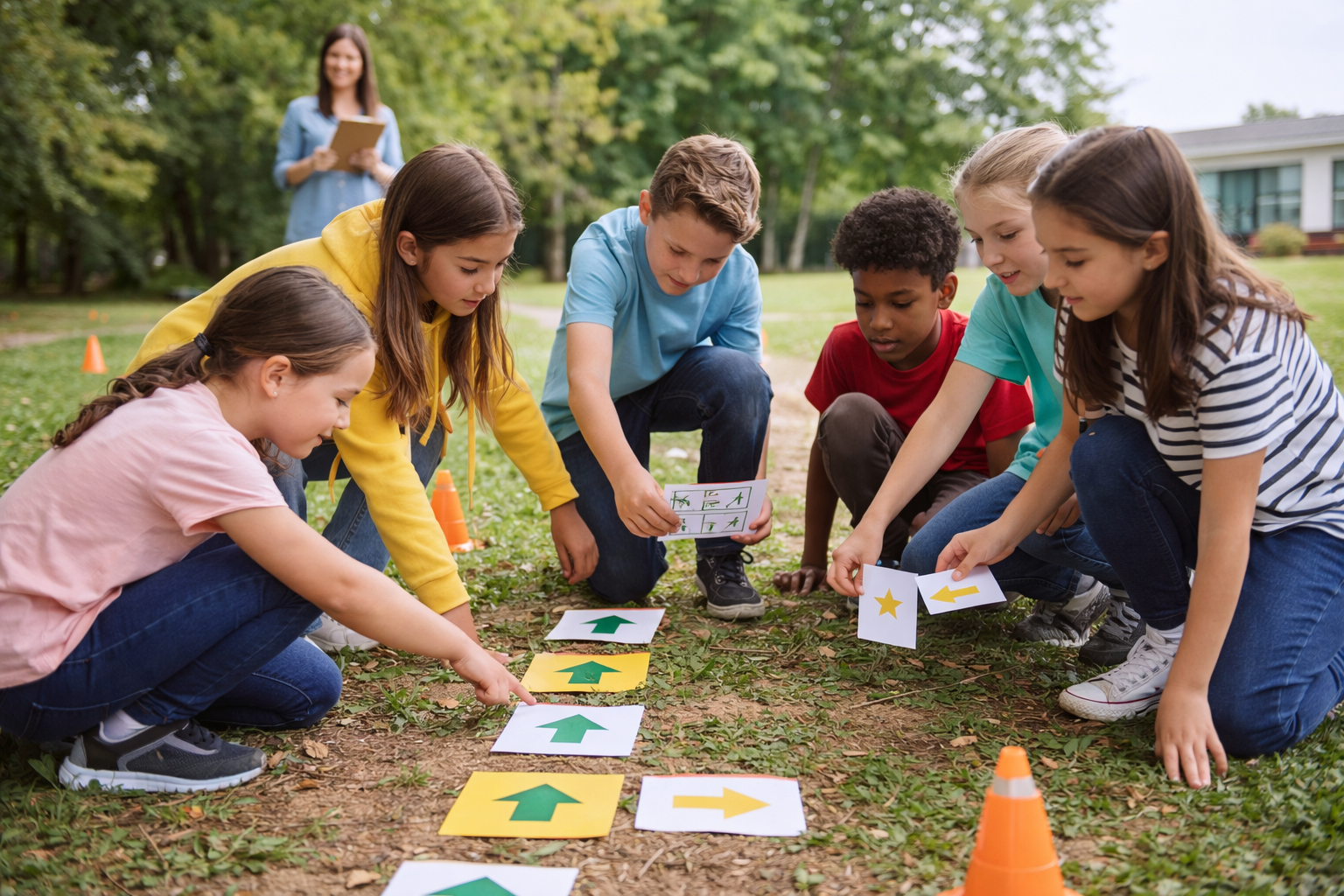
When teachers hear the term gamification, it is often associated with tablets, apps, or digital platforms. However, research increasingly shows that gameful learning does not need technology at all. Well-designed playful activities can be implemented entirely offline, in classrooms, schoolyards, or gym halls, while still producing powerful learning outcomes.
A recent study on unplugged gamification demonstrates how embodied, physically active games such as escape rooms and treasure hunts can significantly enhance students’ learning, engagement, and collaboration (Christopoulos, Mystakidis et al., 2026). Most importantly for schools, these activities require no screens, no devices, and no programming software.
What Is Computational Thinking (and Why It Matters)?
Computational Thinking (CT) is not about learning to code. Instead, it is a way of thinking that helps learners solve complex problems systematically. It includes skills such as:
- Decomposition: breaking a big problem into smaller, manageable parts
- Pattern recognition: identifying similarities and regularities
- Abstraction: focusing on what matters and ignoring unnecessary details
- Algorithmic thinking: creating step-by-step solutions
- Debugging: identifying and correcting mistakes
These skills are essential not only for computer science, but for mathematics, science, language learning, and everyday problem-solving. For teachers, this means that computational thinking can be embedded across subjects, even without digital tools.
How Unplugged Gamification Supports Learning
The research shows that when teachers design learning activities using game principles, such as clear goals, rules, challenges, feedback, and teamwork, students become more engaged and motivated. In unplugged settings, learners use their bodies, movement, discussion, and imagination to solve problems collaboratively.
For example:
- Students physically navigate a space following “algorithmic” instructions
- Teams solve logic puzzles by testing hypotheses and correcting errors
- Learners role-play and negotiate strategies to reach a shared goal
Such activities support deep understanding, encourage peer learning, and help students experience abstract concepts in concrete, memorable ways.
Why This Matters for Schools
Unplugged gamification offers teachers several important advantages:
- It reduces screen time while maintaining high engagement
- It supports inclusive learning, benefiting students with different strengths
- It works in low-resource or technology-restricted environments
- It strengthens collaboration, communication, and critical thinking
This approach fits naturally with the vision of the Most Valuable Play project: learning through meaningful play that values creativity, inclusion, and pedagogical purpose over technology for its own sake.
To explore the full research study and practical examples in detail, you can access the complete article here: https://www.researchgate.net/publication/398356445_Unplugged_gamification_in_education_Developing_computational_thinking_skills_through_embodied_gameplay
The reference for the article is the following:
Christopoulos, A., Mystakidis, S., Stylios, C., & Tsoulos, I. (2026). Unplugged Gamification in Education: Developing Computational Thinking Skills Through Embodied Gameplay. The Journal of Educational Research, 119(1), 77–90. https://doi.org/10.1080/00220671.2025.2517266