

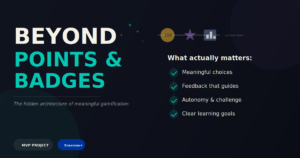
When educators first encounter gamification, the focus often lands on its most visible elements: points, badges, leaderboards, and rewards. These mechanics are easy to implement and can produce quick wins in student engagement. However, relying on surface-level features alone can lead to short-lived motivation or, worse, students who participate only for extrinsic rewards rather than genuine learning.
So, what separates effective gamification from superficial game dressing?
It Starts with Purpose, Not Mechanics
Effective gamification begins with a clear educational goal. Before selecting any game element, teachers should ask: What do I want students to learn and what barriers currently stand in the way? If the challenge is low motivation, gamification might introduce meaningful choices. If the issue is fear of failure, it might focus on safe experimentation and iterative feedback.
Game mechanics are tools, not solutions. Choosing badges before defining your learning objectives is like decorating a house before laying the foundation.
Meaningful Choices Over Empty Rewards
One of the most powerful aspects of games is the sense of agency they provide. Players make decisions, face consequences, and learn from outcomes. Translating this into the classroom means giving students genuine choices: which problem to tackle first, how to demonstrate mastery, or which path to take through a topic.
When choices are cosmetic (such as picking an avatar colour with no impact on learning), students quickly disengage. When choices matter, they invest.
Feedback That Guides, Not Just Scores
In well-designed games, feedback is immediate, specific, and actionable. Players understand what went wrong and how to improve. Compare this to traditional classroom feedback, which often arrives days later as a grade with little explanation.
Gamified learning environments work best when they offer frequent, low-stakes feedback that helps students adjust their approach in real time. This does not require sophisticated technology; even simple self-assessment checklists or peer review activities can fulfil this function.
Challenge and Autonomy: The Motivation Engine
Research on motivation highlights two factors that sustain engagement: 1) appropriate challenge and 2) a sense of autonomy. Games excel at both. Difficulty scales with player ability and players feel they are in control of their experience.
In the classroom, this means designing activities that are neither too easy (boring) nor too hard (frustrating). It also means stepping back as the authority figure and letting students take ownership of their learning journey.
Gamification Without the Tech
None of these principles require digital tools. Analogue games, role-play scenarios, and structured classroom challenges can all embody good game design. In fact, starting without technology often forces educators to focus on the pedagogical substance rather than flashy features.
The Most Valuable Play platform includes resources for both digital and unplugged approaches, helping teachers find the right fit for their context.
Designing for the Long Game
Sustainable gamification is not about tricking students into learning. It is about designing experiences that align with how humans naturally engage, explore, and grow. Points and badges can play a role, but only when embedded in a thoughtfully designed system that prioritises meaning, feedback, challenge, and choice.
As you explore gamification for your own classroom, start with purpose, design with intention, and remember: the goal is not to make learning look like a game but to make it feel as engaging as one.
Want to explore gamification tools and strategies? Visit the Most Valuable Play platform and discover resources designed for teachers by teachers.